
S&P Global Ratings on Tuesday kept India's economic growth forecast in the fiscal year to March 2022 unchanged at 9.5 per cent but raised its predictions for the subsequent year on broadening out of the recovery. The Indian economy had shrunk by 7.3 per cent in 2020-21 fiscal (April 2020 to March 2021) as pandemic induced restrictions battered business activity. The gradual lifting of the restrictions has helped the economy to rebound from pandemic lows.

'India has benefited from lower oil prices and remains the fastest-growing large economy in the world.'

In its macroeconomic review report, the RBI has cut FY13 GDP growth forecast to 5.7% vs 6.5%.

The Indian economy is reviving, helped by positive policy actions.

Government has forecast annual economic growth to rise to 7.4%.
With all-round upturn in economic cycle except in agriculture, Economic think tank NCAER has forecast India's GDP growth rate at 6.5 to 6.7 per cent for this fiscal.

Fitch Ratings on Friday said it has revised the outlook on India's sovereign rating to 'stable' from 'negative' as downside risks to medium-term growth have diminished on rapid economic recovery. Fitch Ratings kept the rating unchanged at 'BBB-'.

The government's second round of stimulus will spur consumer spending in the near term but support to economic growth will be minimal, Moody's Investors Service said.

Very often, 'sentiment' drives prices well beyond what is warranted and it is hard to forecast market sentiment, explains Debashis Basu.

But lower growth numbers in the quarters to come may not mean renewed weakness in the economy at the ground level, says Pranjul Bhandari.

US's terrible political and economic leadership will ultimately cost the dollar its value. India must act early to avoid being dragged down, suggests R Jagannathan.

N R Bhanumurthy, professor of economics at the National Institute of Public Finance and Policy, and the author of the series, presented in a report to the National Statistical Commission, explains to Abhishek Waghmare various aspects of the methodology.
Moody's Investors Service on Friday slashed its estimate of India's GDP growth during the 2020 calendar year to 2.5 per cent from an earlier estimate of 5.3 per cent, on account of the rising economic cost of the coronavirus pandemic.
NCAER on Wednesday forecast a higher 8.13 per cent growth for 2003-04, but warned that fiscal deficit would shoot up to 6.1 per cent of GDP due to increased government expenditure and surging inflation.
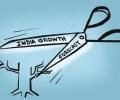
India's projected economic growth for 2022 has been downgraded by over two per cent to 4.6% by the United Nations, a decrease attributed to the ongoing war in Ukraine, with New Delhi expected to face restraints on energy access and prices, reflexes from trade sanctions, food inflation, tightening policies and financial instability, according to a UN report released on Thursday. The UN Conference on Trade and Development (UNCTAD) report downgraded its global economic growth projection for 2022 to 2.6 per cent from 3.6 per cent due to shocks from the Ukraine war and changes in macroeconomic policies that put developing countries particularly at risk. The report said while Russia will experience a deep recession this year, significant slowdowns in growth are expected in parts of Western Europe and Central, South and South-East Asia.

India, along with Southeast Asian countries such as Indonesia, is expected to sustain growth in the medium-term in Asia region, replacing China as the key growth driver, Morgan Stanley and Nomura said in two separate reports released on Monday. While Morgan Stanley projected a 6.2 per cent gross domestic product (GDP) growth forecast for India in FY24, Nomura estimated the Indian economy to grow at 5.9 per cent in 2023. "Even with a slowing China, we expect GDP growth in Asia to sustainably outperform other emerging markets and the US. India and Southeast Asia are set to be the fastest-growing economies this decade.
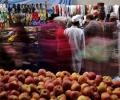
Recent estimates show that foodgrain production in 2016-17 has touched a new record of 273.4 million tonnes or 8.7 per cent higher as compared to last year.

FY17 GDP growth faces cash crunch heat

This is lower than the country's growth rate of 6.7 per cent for the financial year 2008-09.

The April-June quarter GDP slipped to 7 per cent from 7.5 per cent.
Agriculture and allied activities are likely to grow at 5.4 per cent in 2010-11, compared to just 0.4 per cent in 2009-10, according to Advance Estimates released by the Central Statistical Organisation on Monday.
Enthused by a good monsoon, the government on Wednesday said the economy would grow by over 6.0 per cent and could even log near 8.0 per cent growth

Chief Economic Advisor (CEA) V Anantha Nageswaran on Thursday said describing India's recovery as 'K-shaped' was wrong as both rural and urban economies were recovering, albeit at different paces. Speaking to reporters at the Finance Ministry, Nageswaran said the gross domestic product (GDP) growth print for the recent October-December quarter (Q3FY23) will likely be revised upwards. "The notion of using the letter 'K' to denote urban and rural is somewhat wrong because it is almost as if one is growing and one is contracting. "I would say one segment's slope is more positive, and the other one slope is less positive but it is positive," Nageswaran said.

Advance estimates of national income growth released today by the Central Statistical Organisation (CSO) project it at 7.2 per cent in 2009-10, pegging it a notch below earlier forecasts of the Reserve Bank of India (7.5 per cent) and finance ministry (7.75 per cent). With economic growth back on track the government may initiate a phased withdrawal of the fiscal stimulus package.

The wholesale inflation rose to a 13-month high of 1.26 per cent in April fuelled by rising prices of food articles, especially vegetables, amid expectations of RBI holding interest rates in the policy review next month. The wholesale price index (WPI) based inflation has been rising for two months in a row.
December's figure was the seventh successive quarter of economic growth below 5 per cent.

If El Nino condition affects the monsoons, as is being forecast by foreign agencies, it can slow down the economy to 5.2 per cent next fiscal from a projected 6 per cent.

The Nifty Bank index has come off 15 per cent from its peak in February, underperforming the benchmark Nifty which is down 6%.

"A significant decline in the growth number for this quarter is highly likely, but for the fiscal year as a whole the decline may still be relatively moderate," Fitch Asia-Pacific Sovereigns Group Director Thomas Rookmaaker said.

The rupee depreciated 39 paise to an all-time low of 82.69 against the US dollar in early trade on Monday as elevated crude oil prices and risk-averse sentiment among investors weighed on the local unit. Moreover, a negative trend in domestic equities and firm American currency sapped investor appetite, forex traders said. At the interbank foreign exchange, the rupee opened at 82.68 against the greenback, then slipped further to 82.69, registering a fall of 39 paise over its previous close.
.jpg)
Prime Minister's key economic advisor C Rangarajan on Friday lowered the growth forecast for the current fiscal to 5.3 per cent from 6.4 per cent projected earlier and listed out host of measures, including further liberalisation of FDI norms to improve economic condition.

Amid rising geopolitical risks, a vast majority of Indian CEOs have indicated in a survey that they are reducing or planning to reduce operating costs, even as they are more upbeat than their global peers on their country's economic prospects. However, most of the companies do not plan to cut their headcount or salaries, found the annual Global CEO Survey released by consultancy giant PwC here on the first day of the World Economic Forum meeting on Monday. The survey also found that about four in ten CEOs (40 per cent of global and 41 per cent of India respondents) do not expect their companies to be economically viable in 10 years if they continue on their current path.
RBI has retained the GDP forecast at 8.5 per cent for 2007-08; inflation kept close to 5 per cent this year.
The Centre for Monitoring Indian Economy on Monday revised its projection of the GDP during 2003-04 to 8.2 per cent, much higher than the earlier forecast of 7.4 per cent.

The revision will do little to help the Congress party-led ruling alliance, which faces an uphill battle in elections due by May amid allegations of economic mismanagement, corruption scams and high inflation.
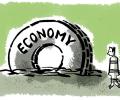
As he projected a grim outlook for the economy, RBI Governor said that amidst this encircling gloom, agriculture and allied activities have provided a beacon of hope on the back of an increase of 3.7 per cent in foodgrains production to a new record.

There are reports that the government will soon cut income taxes by about Rs 50,000 crore to boost consumption.
Prime Minister Modi, I suggest that, instead, you distribute about one lakh crore rupees per year to the 80 crore poor, which will boost both consumption and economic growth, suggests Kalyan Singhal, McCurdy Professor of Business at the University of Baltimore.
The Reserve Bank on Thursday said that the overall stance of its monetary policy for this fiscal would continue to accord a high-priority to price and financial markets stability and well-anchored inflation expectations.

Beside manufacturing, deceleration was also witnessed in sectors like agriculture, construction and electricity, gas and water supply.
